Not sure whether to book a private lesson or join a group class? Here's an honest breakdown to help you decide what actually works for your situation.
You’ve decided you want to learn to dance. Maybe there’s a wedding coming up, maybe you’re tired of standing at the edge of every dance floor, or maybe you just want something new to look forward to after work. Whatever the reason — you’re here, and that’s the hard part.
Now comes the question most people don’t know how to answer: do you take group classes, or book private lessons? Both are real options. Both have genuine advantages. But they’re not the same experience, and the right choice depends entirely on you. Here’s what you actually need to know before you decide.
The simplest way to think about it: group classes are structured around a shared curriculum, and private lessons are structured around you. In a group setting, the instructor moves at a pace that works for most of the room. That’s not a criticism — it’s just how group learning works. In a private lesson, if you need to spend twenty minutes on one thing, you spend twenty minutes on that one thing.
Group classes have real value, especially for social dancing. They put you on the floor with other people, which is exactly the environment you’ll eventually be dancing in. They’re also typically more affordable per session, and there’s an energy to learning alongside others that some people genuinely thrive on.
Private lessons tend to produce faster foundational progress, particularly for adult learners who are starting from scratch. You’re not waiting for the group to catch up, and you’re not falling behind and hoping no one notices. Your instructor is your partner, your coach, and your guide — all at once.
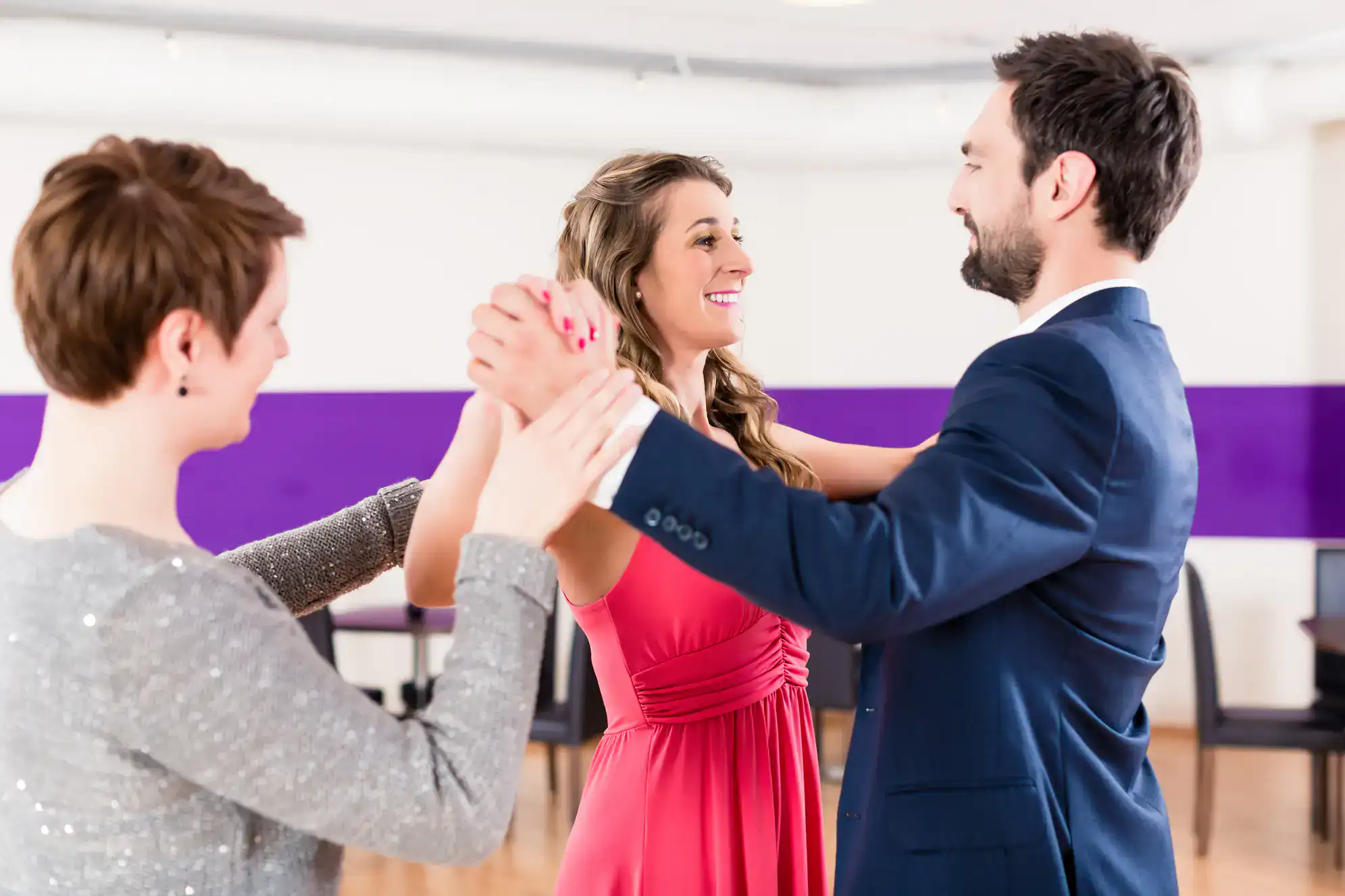
Here’s something most studios won’t say out loud: group classes can be genuinely intimidating for adult beginners. Not because the people are unfriendly, but because adults are not used to being the newest person in the room. When you’re thirty-five or fifty and you’ve never danced before, the fear of falling behind — of being visibly out of sync while everyone else seems to get it — is real. That fear stops a lot of people before they even walk through the door.
One of our students put it plainly in a review: “I hate dancing. I have never danced in my life… I didn’t want to look like an idiot.” She came in because she had a wedding coming up and wanted to feel confident. That’s the situation a lot of adults are actually in, and it’s worth naming directly.
Private lessons remove the audience. You’re not performing for anyone. You’re learning at your own pace, in a space where the only person watching is your instructor — someone who has seen every skill level imaginable and is there specifically to help you improve, not to judge where you’re starting from. For most adult beginners, that environment is what makes the difference between actually learning and giving up after two sessions.
That said, if you already have a little experience and you’re looking for the social aspect — the rotation of partners, the energy of a full class, the feeling of dancing with real people in a real setting — group classes can be a great fit. Our Latin Fundamentals class, for example, covers Salsa, Merengue, and Bachata in a format designed specifically for adults who want to move with ease in a social setting. No partner required.
The honest answer for most true beginners is to start with private lessons, build a foundation, and then use group classes to practice and socialize once you have enough confidence to enjoy the experience rather than survive it.
The format question is really a goals question. What are you trying to accomplish, and how quickly do you need to get there?
If you’re preparing for a wedding first dance, private lessons are almost always the right call. You have a specific song, a specific date, and a specific vision. Custom choreography built around your song and skill level isn’t something a group class can do.
If your goal is social confidence — feeling comfortable at parties, weddings, or a night out — the path is a little more flexible. Private lessons will get you there faster, but group classes will give you the practice reps that translate to real-world settings. Many of our students do both: they use private lessons to build the technical foundation, then join group classes to practice leading, following, and dancing with people they’ve never met before.
If you’re looking for something active, social, and genuinely fun — a reason to get out of the house a few evenings a week — group classes often fit that bill well. There’s a community that forms in those rooms. People come back not just to improve but because they enjoy being there.
And if you genuinely don’t know what you want yet? A single private lesson is a low-risk way to find out. You’ll get a feel for our studio, meet your instructor, and walk away with a clearer sense of what you’re working toward. Most people find that one session answers the question for them.
Want live answers?
Connect with a Ballroom Factory Dance Studio expert for fast, friendly support.
Life in Suffolk County is busy. If you’re commuting into the city or Nassau County, you’re getting home in the early evening with limited time before the night is over. Committing to a fixed group class time every week — and paying for sessions you miss — is a real obstacle for a lot of people here.
Private lessons flex around your schedule, not the other way around. If something comes up, you reschedule. You’re not losing a session fee because your LIRR train ran late or your kid’s schedule shifted. That flexibility isn’t a minor perk — for a lot of adults across Suffolk County, it’s the reason they’re actually able to start and stick with lessons.
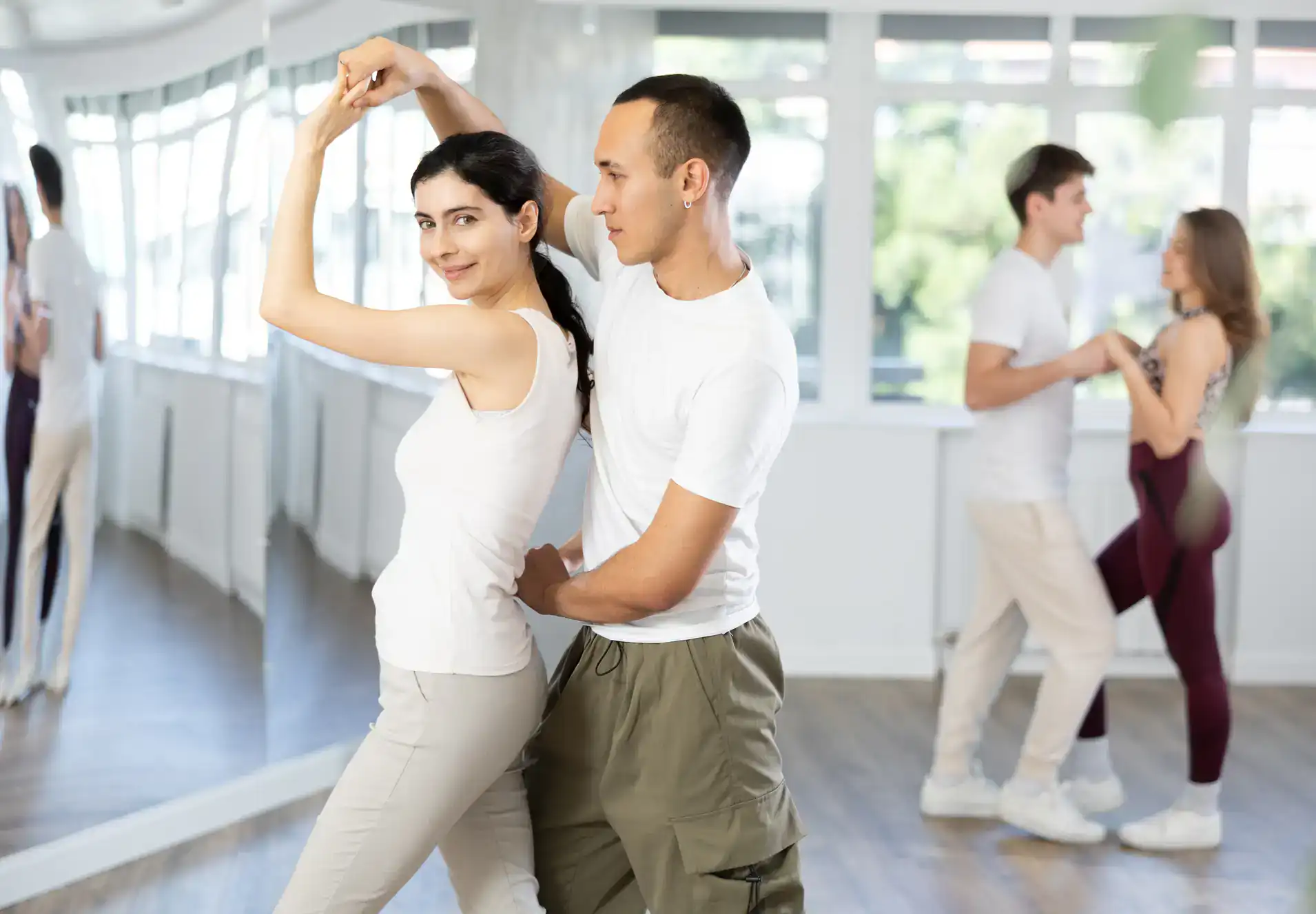
There’s a reason private instruction is the standard recommendation for adult learners who want to see results quickly. When your instructor’s attention is entirely on you, feedback is immediate and specific. You’re not watching from the back of a group trying to mirror what someone else is doing — you’re learning the mechanics of movement with someone who can see exactly what your body is doing and correct it in real time.
This matters more than most people expect. A lot of what feels like “natural talent” in dancing is really just good early instruction. When foundational habits are set correctly from the beginning — posture, weight transfer, timing, connection with a partner — everything that comes after gets easier. When those habits are set incorrectly in a group setting where the instructor can’t watch every student at once, they’re much harder to undo later.
At our studio on Waverly Ave in East Patchogue, our instructors — including Pavel, Mitch, and Karolina — work with students across every skill level, from absolute beginners to competitive dancers. What gets mentioned consistently in reviews isn’t just the quality of instruction during lessons; it’s the fact that instructors are watching and coaching even during practice time, because they genuinely care about how students progress. That kind of attention is hard to find, and it’s the thing that separates a transformative experience from a forgettable one.
We offer more than a dozen styles — Waltz, Tango, Foxtrot, Cha-Cha, Rumba, Salsa, Bachata, Swing, and more — which means you’ll never outgrow the studio. A student who starts with wedding prep can move into social Latin dancing, or pick up Viennese Waltz, or try Hustle, without ever needing to look elsewhere.
Most people comparing adult dance class formats only think about two options: group or private. But there’s a middle ground that often gets overlooked — semi-private lessons, where a small number of students (typically two to four) share a session with one instructor.
Semi-private lessons give you more individual attention than a standard group class, at a lower cost per person than a fully private session. For couples who want to learn together, or for two friends who want to take lessons without the full private rate, it’s a practical option that balances personalization with affordability.
The key difference from a large group class is the ratio. In a semi-private setting, the instructor can actually watch what you’re doing and give you feedback that’s specific to you — not general corrections shouted across a room of fifteen people. You still get the social element of learning alongside someone else, but the instruction is genuinely tailored rather than averaged across a crowd.
For adults in Suffolk County who are price-conscious but know they’d struggle in a large group setting, semi-private lessons are worth asking about. They’re not always advertised prominently, but they’re a legitimate format that works well for the right situation.
One thing worth knowing regardless of which format you choose: you do not need a partner to start. During private lessons, your instructor is your partner. In group classes, partner rotation is standard. Coming alone is not just acceptable — it’s common. If the assumption that you need to show up as a couple has been holding you back, set it aside.
If you’re a true beginner, have a specific goal or deadline, or know you’ll learn better without an audience, private lessons are likely your best starting point. If you have some experience, want the social energy of a full class, or are primarily looking for a fun, active community to be part of, group classes are worth exploring. And if you’re somewhere in the middle, semi-private lessons might be the answer you didn’t know to ask about.
There’s no universally right answer here — but there is a right answer for your situation. The best thing you can do is have an honest conversation about what you’re actually trying to accomplish.
We work with adults across Suffolk County — from Bay Shore and Babylon to Hauppauge, Holbrook, and everywhere in between — and the first step is always the same: figuring out what you want and building a plan around that. Reach out, ask your questions, and see what fits.
—
**Frequently Asked Questions**
**Do I need a partner to take adult dance classes in Suffolk County?** No. This is one of the most common assumptions that keeps people from starting, and it’s simply not true. In private lessons, your instructor is your partner. In group classes, rotation is built into the format — you’ll dance with multiple people throughout the session. A large portion of our students at our East Patchogue studio come alone, and they fit right in from day one.
**How many lessons do I need before my wedding?** It depends on your starting point and how complex you want the choreography to be, but most couples we work with in Suffolk County begin three to six months before their wedding date. That timeline gives us enough sessions to build something that feels genuinely like yours — not a generic routine you learned in four weeks. If your date is closer than that, reach out anyway. We’ll tell you honestly what’s achievable.
**What should I look for in a ballroom dance teacher?** Experience matters, but so does the ability to actually teach — those are two different skills. A great ballroom dance teacher can break down movement in a way that makes sense to you, adjust their approach based on how you learn, and make you feel capable rather than frustrated. Look for instructors with verifiable credentials, specific student outcomes (not just vague praise), and a studio culture that matches how you want to feel when you walk in the door. In Suffolk County, where independent studios dominate the market, reputation and instructor relationships tend to be the most reliable signal of quality.
**Is it too late to start dancing as an adult?** No. We work with adults in their 30s, 40s, 50s, and beyond — including students who have never danced a single step in their lives. Structured dance programs significantly improve physical, psychological, and cognitive health outcomes for adults at any age. More importantly, so is the experience of students who walk in nervous and leave with something they didn’t expect: confidence.
Summary:
Article details:
Share: