Confused about where to start with ballroom dance? This guide breaks down every major style in plain terms so you can stop guessing and start moving.
Most people who walk through our door have the same question before they even say hello: “Which dance should I learn?” It’s a fair question — and an overwhelming one when you realize “ballroom dance” isn’t a single style. It’s an umbrella term covering more than 20 partner dances, split across two major categories with completely different rhythms, footwork, and feelings.
The good news is you don’t need to know all of them before you start. You just need enough to make a confident first choice. Here’s a plain-language breakdown of the main types of ballroom dances — what they are, how they feel, and which one might be the right fit for you.
The first thing to understand is that all ballroom dance styles fall into one of two broad families: Standard (sometimes called Smooth in the American system) and Latin (sometimes called Rhythm). These aren’t just categories on a competition scoresheet — they describe two genuinely different movement philosophies.
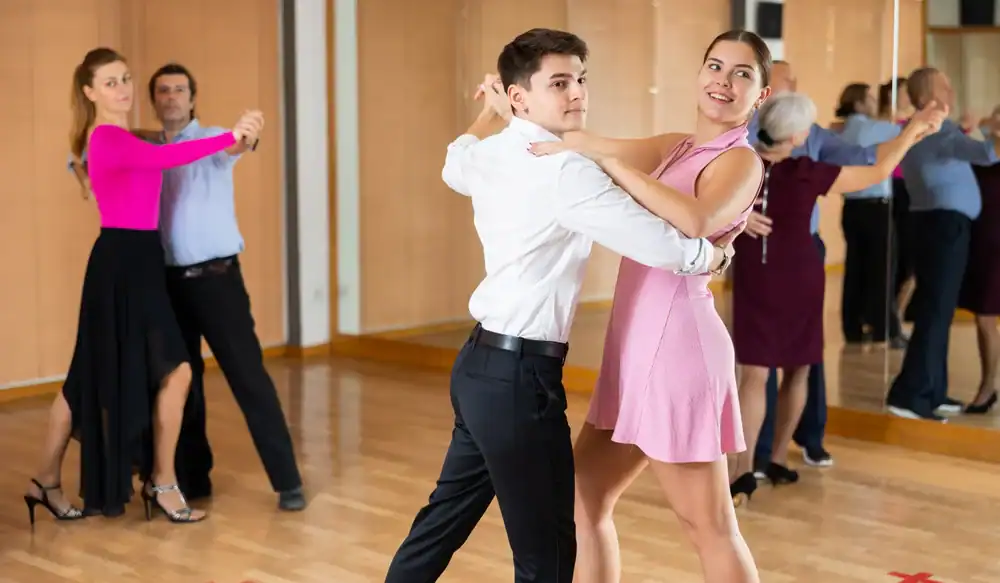
Standard dances are characterized by an upright, elegant posture. Partners stay in a closed hold for most of the dance, moving together across the floor in long, sweeping patterns. Think formal ballrooms, big-band music, and the kind of dancing you’d see at a black-tie gala. Latin dances are the opposite energy — grounded, expressive, and driven by hip movement. Partners often break apart, improvise, and feed off each other’s rhythm. These are the dances you feel in your chest before your feet even move.
Neither category is harder than the other. They’re just different. And knowing which one speaks to you is usually the fastest way to figure out where to start.
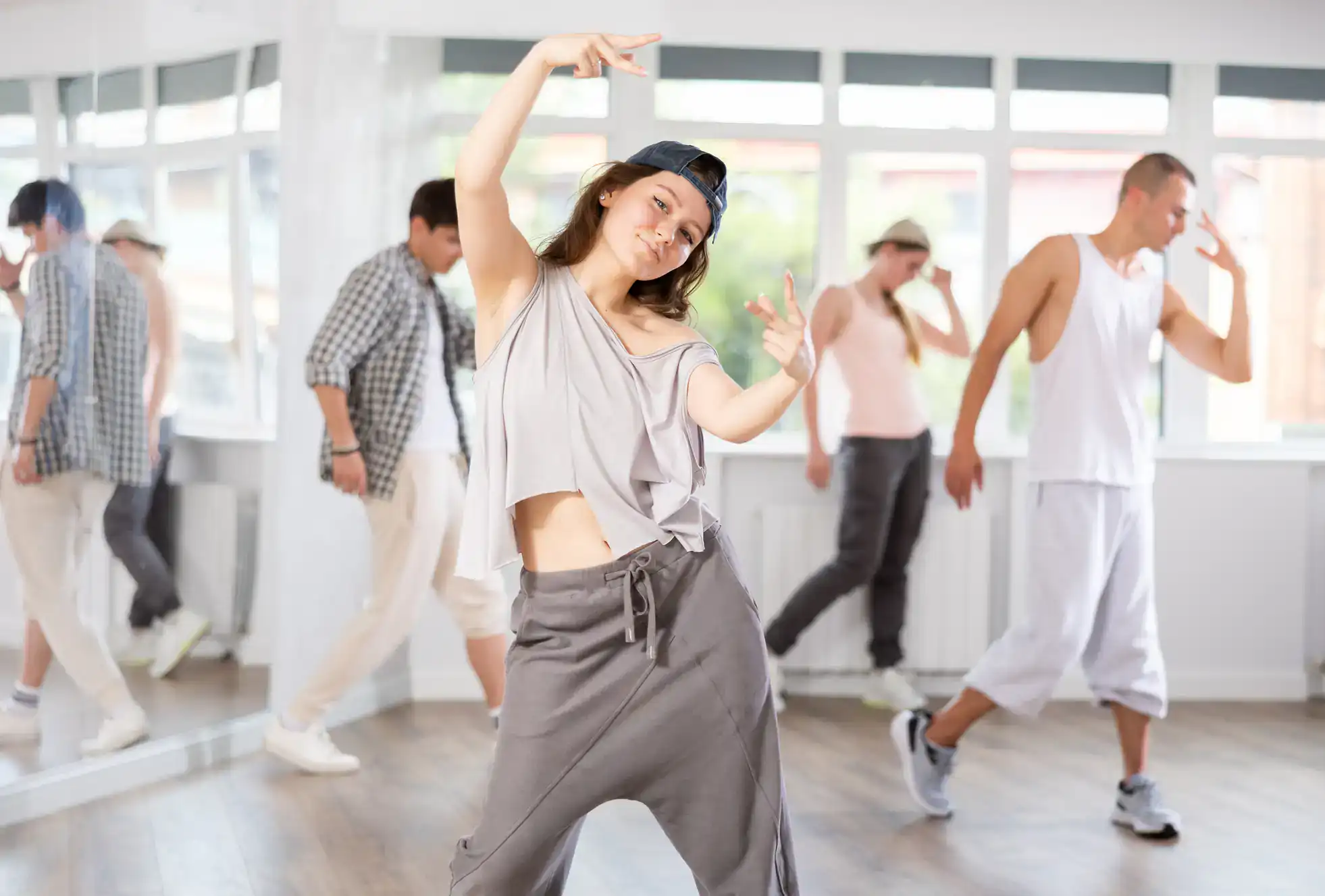
The Standard category includes five dances recognized by the World Dance Council: Waltz, Tango, Viennese Waltz, Foxtrot, and Quickstep. Each has its own tempo, character, and technical demands — but they share that signature upright frame and the feeling of two people moving as one unit across the floor.
The Waltz is probably the most recognized ballroom dance in the world. Danced in 3/4 time at a gentle 28 bars per minute, it has a rise-and-fall quality that gives it that characteristic floating sensation. It’s romantic, measured, and surprisingly accessible for beginners once you internalize the three-count rhythm. A lot of couples choose the Waltz for their wedding first dance — and for good reason. It’s timeless, it photographs beautifully, and it doesn’t require you to move fast.
The Foxtrot dance is arguably the best starting point for anyone new to Standard ballroom. Danced in 4/4 time with a slow-slow-quick-quick pattern, it’s smooth, versatile, and works with an enormous range of music — from classic big-band standards to contemporary pop ballads. Fred Astaire made it famous. What he didn’t advertise was how learnable it actually is. The rhythm is intuitive, the movements are natural, and the technique you build in Foxtrot transfers directly to other Standard dances. If you’re not sure where to begin, Foxtrot is almost always the answer.
The Tango is a different animal entirely. Sharp, dramatic, and driven by tension between partners, it’s the one dance where the music almost doesn’t matter — the connection between the two dancers is the whole story. Ballroom Tango (as distinct from Argentine Tango, which is its own style) uses a staccato footwork pattern and a distinctive head snap that makes it instantly recognizable. It takes longer to feel natural than the Waltz or Foxtrot, but the payoff — in terms of stage presence and sheer confidence — is hard to match.
The Viennese Waltz is the faster, older cousin of the standard Waltz, rotated continuously around the floor at nearly double the tempo. It’s exhilarating to watch and genuinely demanding to execute well. Most instructors recommend building a foundation in the standard Waltz before attempting it. The Quickstep rounds out the Standard category — a high-energy, syncopated dance that blends elements of Foxtrot with faster footwork and playful hops. It’s one of the most fun dances to watch at a competition, and one of the more challenging to learn.
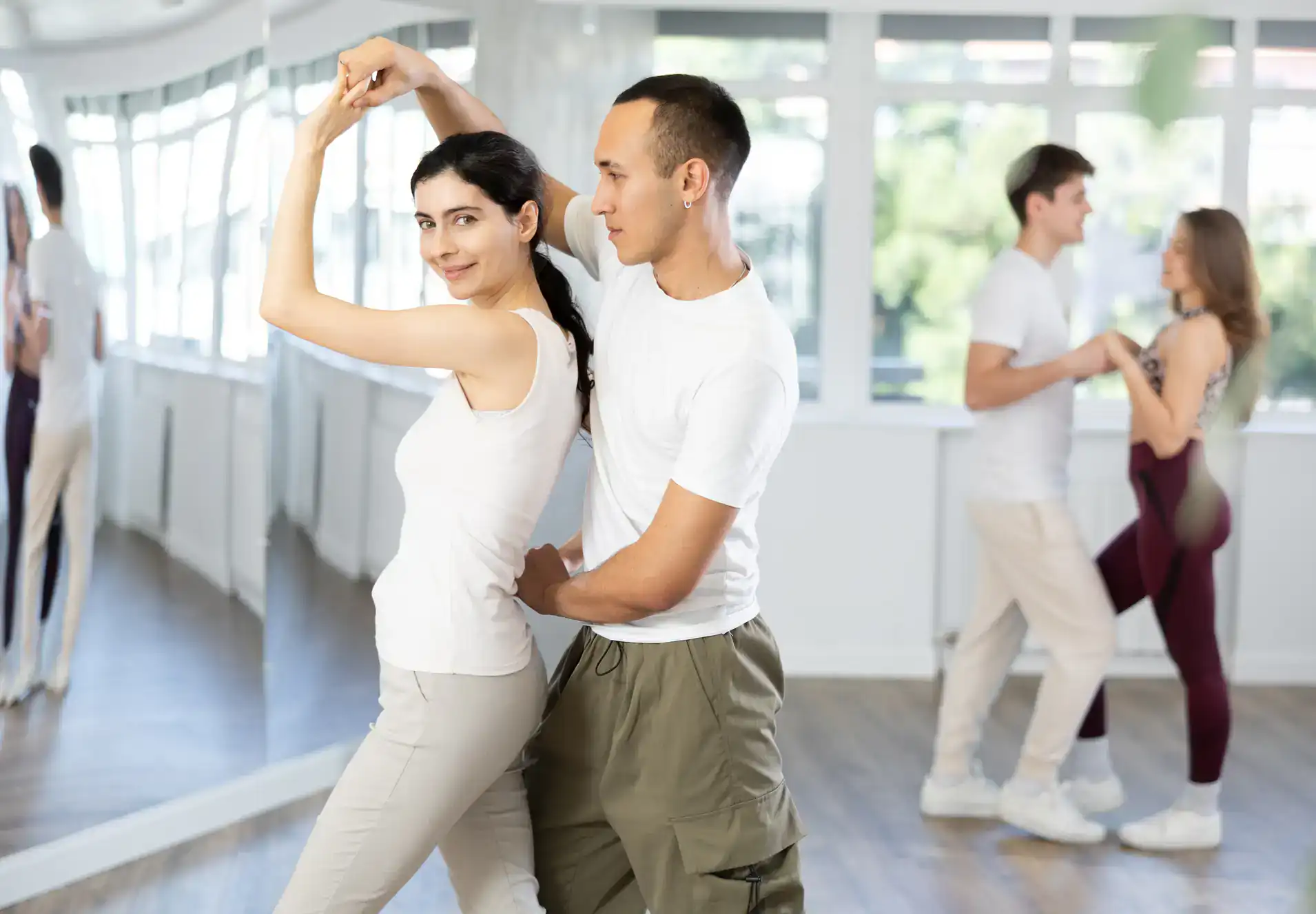
Latin ballroom styles are built around hip movement, rhythm, and expression. Where Standard dances ask you to be controlled and precise, Latin dances ask you to be present — in your body, in the music, in the connection with your partner. The five internationally recognized Latin dances are Cha-Cha, Samba, Rumba, Paso Doble, and Jive, but in social and studio settings, you’ll also encounter Salsa, Merengue, Bachata, and Mambo, all of which share Latin roots.
The Cha-Cha is one of the most popular dances in the world — and one of the most fun to learn. Its count (2-3-cha-cha-cha) is distinctive, its energy is playful, and its hip action is what most people picture when they think of Latin dance. It’s a great entry point for anyone drawn to Latin styles, partly because the rhythm is so clear and partly because it doesn’t require a lot of floor space. You can Cha-Cha in a crowded ballroom or a backyard wedding reception with equal success.
The Rumba is often called the “dance of love” — and it earns the label. Slower and more sensual than the Cha-Cha, it’s driven by the connection between partners rather than the energy of the room. The hip movement in Rumba is more deliberate, the pauses more meaningful. Many couples who want something emotionally resonant for a first dance gravitate toward Rumba when they realize the Waltz feels too formal for their song. It works beautifully with R&B, soul, and slower pop music.
Salsa is technically outside the competitive ballroom system, but it belongs in any honest conversation about Latin dance styles. It’s the most socially ubiquitous Latin dance in the United States — and here in Suffolk County, where roughly one in four residents has Latin American heritage, it’s not just a dance style, it’s a cultural touchstone. Salsa is fast, improvisational, and built for social dancing. Learning even the basics opens up an entire world of events, clubs, and social gatherings where you can actually use what you’ve learned the same week you learn it.
The Samba brings Brazilian carnival energy to the ballroom — bouncy, rhythmically complex, and genuinely joyful. The Paso Doble is theatrical and dramatic, modeled after the Spanish bullfight. The Jive is the Latin category’s most high-energy entry: fast, bouncy, and rooted in American swing and rock-and-roll. If you’ve ever watched a competition and seen two dancers absolutely exploding with energy at the end of their Latin routine, they were probably doing Jive.
Want live answers?
Connect with a Ballroom Factory Dance Studio expert for fast, friendly support.
Knowing what all the dances are is useful. Knowing which one to start with is the actual question. And the honest answer is: it depends on why you want to dance in the first place.
Your goal matters more than your personality type, your fitness level, or how many times you’ve been told you have two left feet. Someone preparing for a wedding first dance has different needs than someone who wants to feel confident at a company holiday party. Someone who wants a fun date-night activity is in a different place than someone eyeing a local competition. The dance that’s right for you is the one that serves your actual goal — and the one you’ll actually enjoy practicing.
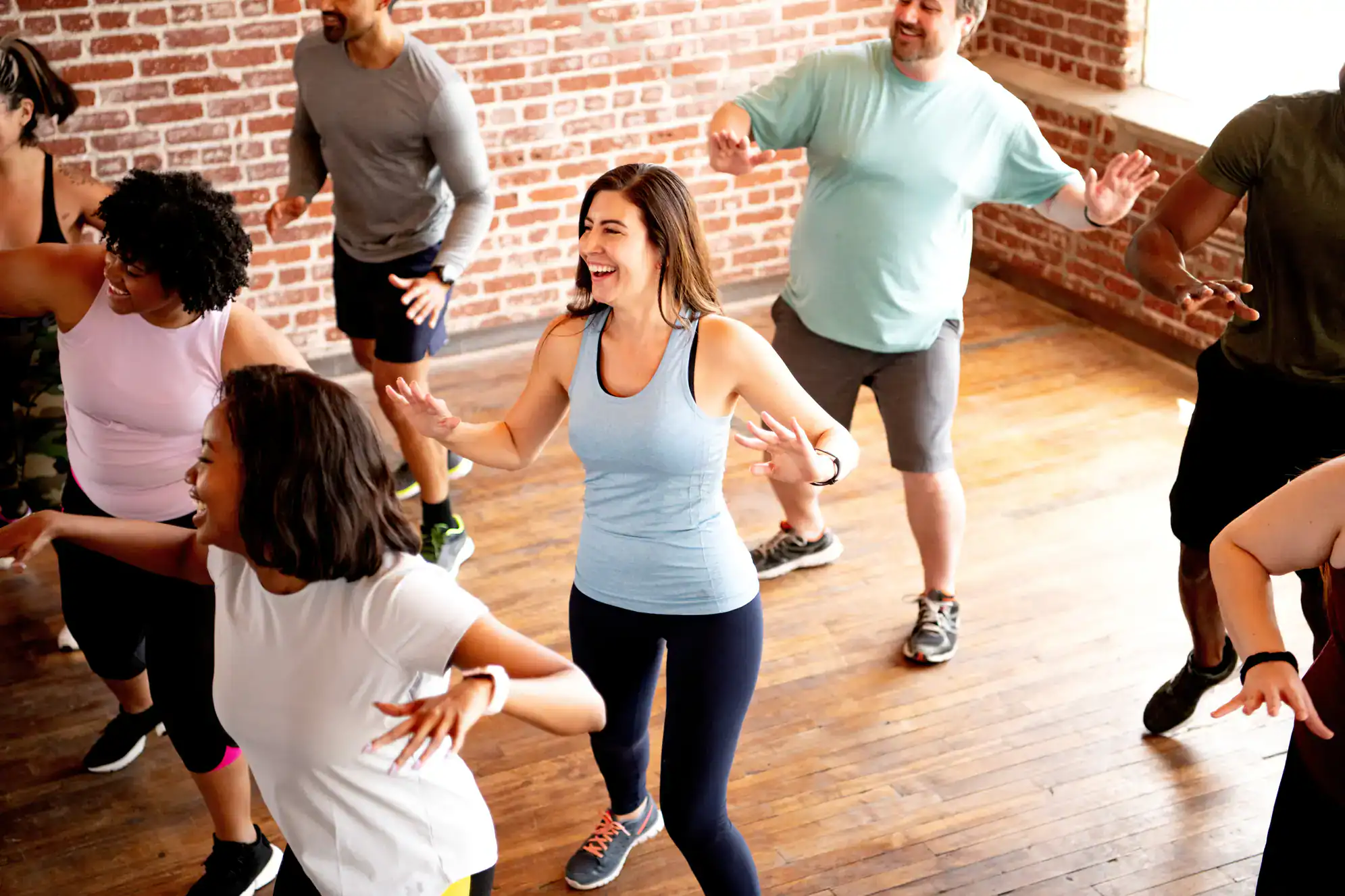
If you’re preparing for a wedding, the Waltz and Foxtrot are consistently the most popular choices among couples who come to us at Ballroom Factory Dance Studio. Both are learnable in 6–8 lessons for most people, both translate beautifully to a wide range of songs, and both look genuinely elegant on the dance floor without requiring years of training. The Rumba is a strong alternative for couples whose song has a slower, more intimate feel. We’ve helped dozens of Suffolk County couples build a first dance routine from scratch — many of them starting with zero dance experience — and every single one has walked out of their last lesson ready.
If your goal is social dancing — the kind that serves you at parties, galas, charity events, or the growing number of social dance nights that happen across Long Island — Foxtrot and Cha-Cha are the two most versatile starting points. Foxtrot works with almost any slow-to-medium tempo music. Cha-Cha works at most Latin-leaning events and is easy to adapt to modern pop. Between the two, you’d cover the majority of social dance situations you’ll actually encounter.
If you’re drawn to Latin styles specifically, start with Cha-Cha or Salsa. Both are high-reward early on — you’ll feel the rhythm quickly, and the learning curve doesn’t require you to master complex partnering technique before the dance starts to feel good. From there, Rumba and Samba are natural progressions that deepen your Latin foundation considerably.
For anyone who’s simply not sure — which is most people — that’s exactly what a first lesson is for. We don’t hand every new student the same starter dance. We ask questions, we watch how you move, and we make a recommendation based on your actual goals and the music you actually like. That conversation usually takes about ten minutes and saves months of learning something that wasn’t the right fit.
One of the most common things we hear from new students is some version of: “I was terrified to walk in.” That’s not an exaggeration — the fear of looking foolish is real, and it stops a lot of people from ever making the call. What those same students say after their first lesson is almost always the same thing too: “I don’t know why I waited so long.”
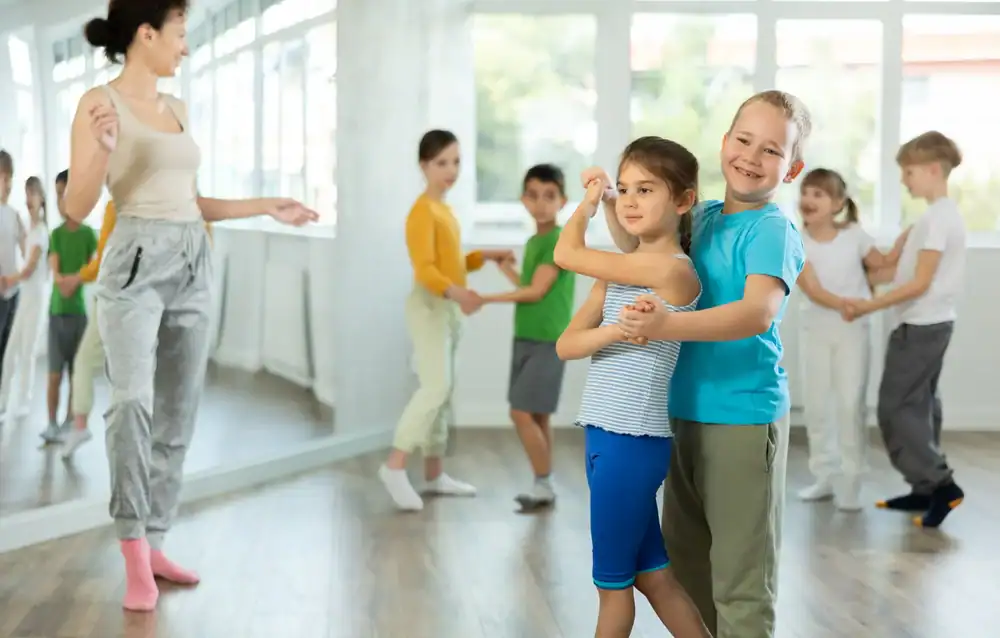
Here’s what actually happens when you start. You come in, you meet your instructor, and you have a conversation — not an audition. Nobody expects you to know anything. Nobody is watching you from across the room. Private lessons at our Patchogue studio are one-on-one, which means the only person in the room with you is an experienced instructor whose entire job is to make you feel capable and at ease. The mirrors on the wall aren’t there to intimidate you. They’re there so you can see yourself improving in real time.
Most beginners start to feel the rhythm of their chosen dance within the first two or three lessons. By six to eight lessons, most people have a solid foundation — enough to feel comfortable at a social event, execute a wedding first dance, or decide they want to keep going and learn something new. There’s no pressure to commit to a long-term program before you know whether this is something you love. We’ve seen students come in for eight lessons before a wedding and leave as regulars who’ve been coming back for years.
The ball room dance styles we teach span the full range — Standard, Latin, and social dances — so if you start with Waltz and decide three months later that Salsa is actually your thing, you don’t have to find a new studio. Everything is here. Our instructors have worked with students from across Suffolk County, from Patchogue to Smithtown to the East End, and the one thing that holds true regardless of where someone is starting from is this: the biggest barrier is never coordination. It’s always just getting through the door the first time.
We also offer group classes for students who enjoy a social environment, practice sessions on Friday evenings, and seasonal showcases — including our Spring Showcase & Dinner Dance — that give students a real performance goal to work toward. Dance, at its best, is a community. That’s something you feel the first time you walk into a room full of people who all started exactly where you are now.
There are over 20 types of ballroom dances, and none of them require you to be naturally gifted, young, or already coordinated. What they require is a willingness to show up and a teacher who knows how to meet you where you are. The rest is just practice.
If you’ve been sitting on the idea of learning to dance — for a wedding, for a social event, for yourself — this is the moment to stop thinking about it and start. The styles are learnable. The timeline is shorter than you expect. And the feeling of actually knowing how to move on a dance floor is one of those things people consistently describe as genuinely transformative.
Ballroom Factory Dance Studio is located at 620 Waverly Ave in Patchogue, NY, and serves students from more than 50 communities across Suffolk County. Reach out to schedule your first lesson — and let the dance tell you which style was yours all along.
Summary:
Article details:
Share: