Not every dance teacher is the real deal. Here's what qualifications actually matter before you sign up for salsa dance lessons.
You’ve decided you want to learn salsa dance. Maybe it’s for a wedding, a date night, or just something you’ve been putting off for years. You search around, find a few studios in Suffolk County, and they all say the same thing — experienced instructors, welcoming environment, great results.
So how do you actually tell the difference?
The truth is, dance instruction is an unregulated field in New York. Anyone can call themselves a dance teacher. That makes your job as a consumer harder — but it also means knowing what to look for puts you well ahead of most people walking through a studio door. Here’s what actually matters.
This is the most common misconception in the dance world: that being a great dancer automatically makes someone a great teacher. It doesn’t. These are genuinely different skill sets, and confusing them is how students end up frustrated after months of lessons with little to show for it.
A professional dance teacher understands how to break movement down, adapt to how different people learn, and build a student’s skills in a logical sequence. They can explain why a step works — not just show you what it looks like. That distinction matters enormously, especially in the early stages when the habits you build are the ones you’ll carry forward.
For ballroom dance styles — Waltz, Tango, Foxtrot, Cha-Cha, Rumba — the industry has a well-established credentialing system. The National Dance Council of America (NDCA) is the governing body in the United States, and several organizations operate under its umbrella to certify instructors. DVIDA (Dance Vision International Dancers Association) is one of the most widely respected. To earn certification, an instructor doesn’t just have to dance well — they have to demonstrate that they can teach. That means explaining technique clearly, describing footwork and timing with precision, and showing competency for both the leader and follower roles. That last part matters more than most students realize. An instructor who only knows their own part of the dance has a real ceiling on what they can teach you.
Other recognized certifying bodies include the North American Dance Teachers Association, the U.S. Imperial Society of Teachers of Dancing, and Arthur Murray International, among others. These aren’t just pieces of paper — they represent a standardized benchmark that separates instructors who have been formally evaluated from those who haven’t.
For salsa dance specifically, the situation is a bit different. There’s no single universal certification the way there is for ballroom. The World Salsa Federation has offered a structured program since 2001, but the salsa world more broadly judges credibility through demonstrated results — competition history, the quality of dancers a teacher produces, invitations to teach at recognized congresses and events. A qualified salsa instructor should be able to explain the difference between New York style, Los Angeles style, and Cuban style, understand music structure and timing deeply, and have a clear method for teaching lead-and-follow mechanics — not just choreography.
The absence of a universal salsa certification is actually a reason to ask more questions, not fewer. Any instructor worth their time will have a clear answer when you ask about their training background.
Some of these are obvious once you know them. Others are easy to miss if you’ve never taken dance lessons before.
The first thing to notice is whether the instructor can explain what they’re teaching or only demonstrate it. Demonstration is part of good instruction — but if they can’t tell you why your weight transfer happens on a certain beat, or why your frame needs to be held a specific way, that’s a gap. Good technique has reasons behind it. A qualified instructor knows those reasons and can communicate them clearly.
Watch for instructors who only know one side of the dance. In salsa and ballroom both, the leader and follower roles require different skills and cues. An instructor who has only ever danced one role will have blind spots — and those blind spots become your blind spots.
High-pressure sales tactics are another warning sign the dance community talks about openly. Long-term contracts pushed on first-time visitors, urgency around limited spots, or resistance to letting you try a single lesson before committing — these are patterns worth taking seriously. A studio that’s confident in what it offers doesn’t need to pressure you into staying.
Finally, pay attention to whether students actually progress. Ask if the studio hosts showcases or social events. Ask if students go on to dance at their weddings, at parties, or in competitions. A studio with a real community around it — events, performances, returning students — is a studio where people are getting results.
Want live answers?
Connect with a Ballroom Factory Dance Studio expert for fast, friendly support.
Instructor quality isn’t just about safety or avoiding bad habits — though both of those matter. It’s about the return on your investment of time and money. Lessons with a qualified instructor move faster, feel better, and stick longer. The things you learn in your first few months are the foundation everything else is built on. If that foundation is shaky, it takes real work to correct later.
When the instruction is right, progress happens in ways that surprise people. Students who walked in convinced they had two left feet find themselves actually enjoying the dance floor. That shift doesn’t come from talent — it comes from good teaching.
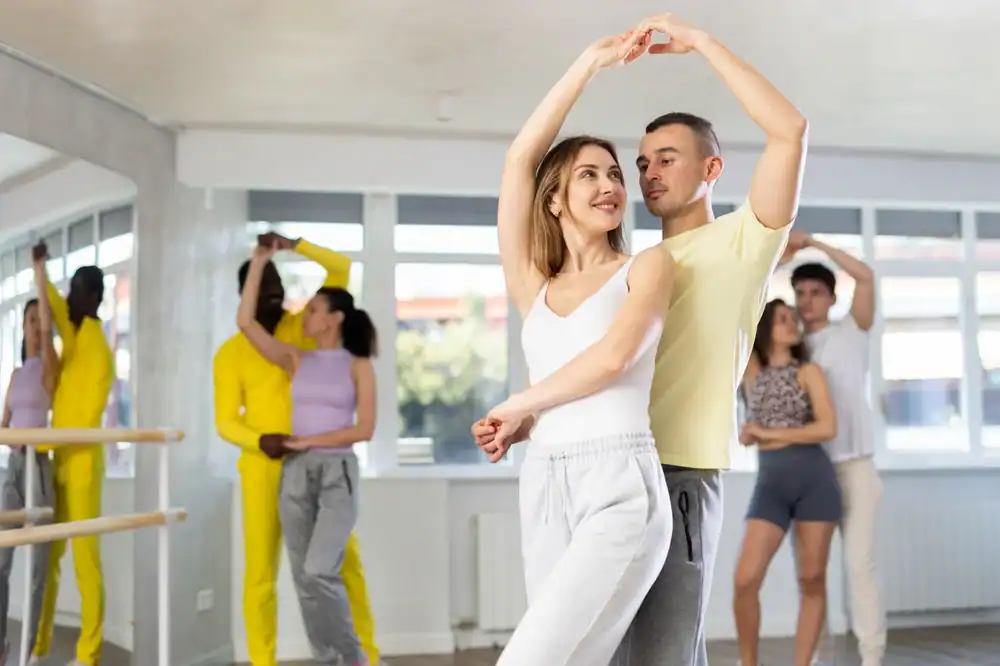
One of the clearest markers of a qualified instructor is how they adapt to the person in front of them. Not everyone learns the same way. Some people are visual learners who need to watch a movement before they try it. Others need to feel the mechanics first and figure out the visual later. Some people come in with prior dance experience and need refinement; others are starting from zero and need a completely different entry point.
A cookie-cutter class structure can’t account for any of that. When instruction is genuinely personalized — when your teacher builds a plan around your goals, your timeline, and how you actually learn — the experience is fundamentally different. You’re not keeping up with a group or waiting for others to catch up. You’re moving at a pace that makes sense for you.
This matters especially for goal-driven students. If you’re preparing for a first wedding dance, you need a specific set of skills by a specific date. A qualified instructor will assess where you are, identify exactly what needs to happen between now and then, and build a plan that gets you there. That’s not magic — it’s just good teaching applied to a clear objective. The same principle applies whether the goal is social dancing, competitive performance, or just finally feeling comfortable on the dance floor at a family event.
New York State does not require dance instructors to hold a license. That’s not a criticism of the industry — it’s just the regulatory reality. It means the responsibility for vetting an instructor falls entirely on you, the student. Across Suffolk County, with dozens of studios spread across communities from Patchogue to Smithtown to Bay Shore, the range in instructor quality is wide.
That’s worth naming plainly. Some instructors throughout the county are genuinely exceptional — credentialed professionals with competition backgrounds, years of teaching experience, and students who go on to dance at their weddings, perform in showcases, and come back year after year. Others are enthusiastic beginners who took a short course and hung out a shingle.
Suffolk County also has a large and culturally rooted Latino community — roughly 23% of the county’s population — for whom salsa, merengue, and bachata carry real cultural significance. That’s not a market to underserve with casual instruction. It deserves the same professional standard as any other style.
The questions worth asking before committing to any studio: What formal training does your instructor have? Can they teach both roles in the dance? Do you offer a trial lesson? What do your students go on to do after lessons here? A studio with nothing to hide will answer all of those without hesitation.
The short version: look for formal credentials, ask about teaching experience specifically (not just dancing experience), watch for red flags around sales pressure and one-sided technique, and find a studio where students visibly progress.
Instructor quality is the variable that determines almost everything else about your experience — how quickly you improve, how confident you feel, whether you keep going or quietly quit after a few months.
We’re Ballroom Factory Dance Studio, located at 620 Waverly Ave in Patchogue, NY. Our instructors are award-winning professionals who teach the full range of Latin and ballroom styles, including salsa dance. We work with students across Suffolk County at every skill level, and every lesson we offer is built around what you’re actually trying to accomplish. If you’re ready to find out what the right instruction feels like, we’d genuinely love to show you.
Summary:


Article details:
Share: