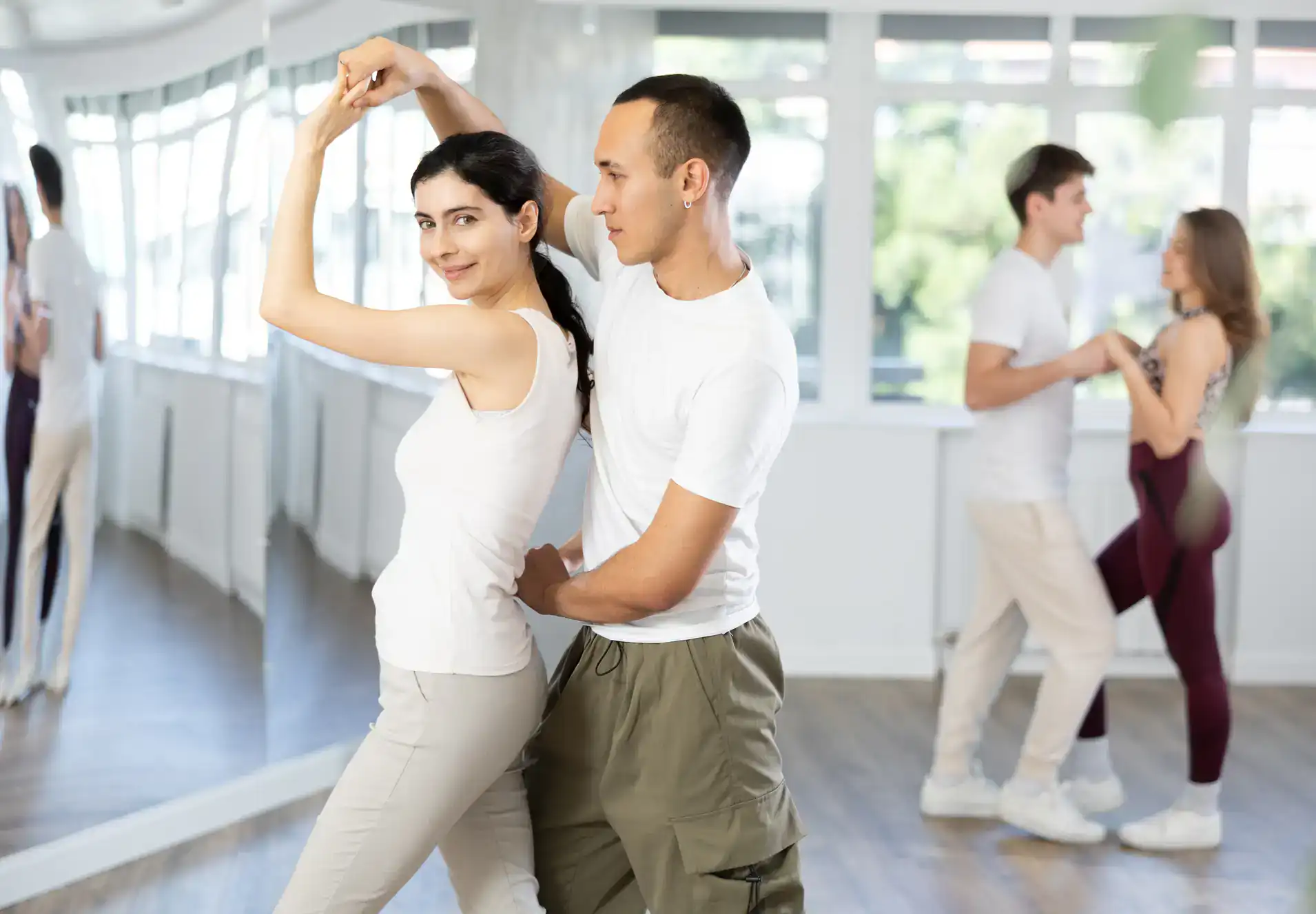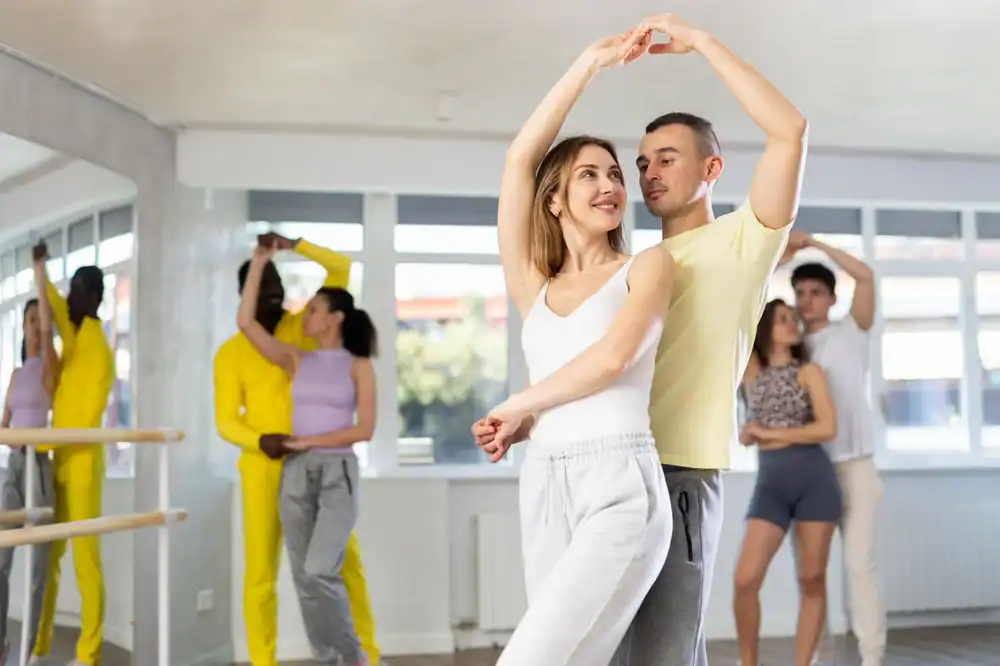
Not sure which ballroom dance to learn first? Waltz, Foxtrot, and Cha-Cha top the list for beginners—and they're easier than you think.
You want to learn ballroom dancing, but you’re not sure where to start. Maybe you’re preparing for a wedding first dance. Maybe you’re looking for a fun way to connect with your partner or meet new people. Either way, the question is the same: which dance should you learn first?
Here’s the good news. Some ballroom dances are genuinely easier to pick up than others. They use fewer steps, slower tempos, and more forgiving rhythms. They let you focus on feeling comfortable with a partner instead of memorizing complicated footwork.
In this guide, you’ll learn which beginner ballroom dance styles are the most approachable, why they work so well for new dancers, and how to choose the right one for you. Let’s start with the dance that’s often called the foundation of ballroom.
The Waltz is often the first dance people picture when they think of ballroom. There’s a reason for that. It’s elegant, romantic, and surprisingly simple to learn.
The Waltz uses just four basic steps in a repeating box pattern. The timing is slow and steady—three beats per measure—which gives you time to think, adjust, and stay in sync with your partner. You’re not rushing. You’re gliding.
That slow pace is what makes the Waltz so forgiving. If you miss a step or lose your place, you have a moment to recover without the whole thing falling apart. For someone who’s never danced with a partner before, that breathing room matters.
The Waltz works for beginners because it strips away the complexity. You’re learning to move with another person, hold a frame, and stay on beat—all foundational skills. But you’re doing it at a manageable speed with a pattern that repeats.
The box step is the core of the Waltz. You step forward, side, together. Then back, side, together. That’s it. Once you understand that sequence, you can start adding turns, but you don’t have to. Even the basic box step looks polished when done with good posture and smooth movement.
The three-quarter timing also makes the Waltz feel natural. It’s the same rhythm you hear in classic songs, lullabies, and wedding music. Your body already knows how to sway to it. You’re just adding structure.
One of the biggest challenges beginners face with the Waltz is staying connected to their partner. It’s easy to focus so much on your own feet that you forget you’re dancing with someone else. That’s where an instructor helps. At Ballroom Factory Dance Studio in Suffolk County, NY, we teach you how to maintain a frame, communicate through your hands, and move as a unit. Those skills carry over to every other dance you learn.
The Waltz also builds confidence. Because the steps are simple, you can focus on how you feel while dancing—not just what your feet are doing. You start to notice the music. You start to relax. That’s when dancing stops feeling like a chore and starts feeling like something you actually enjoy.
Another reason the Waltz is ideal for beginners is its versatility. It works for wedding first dances, social events, and even competitive ballroom if you decide to take it further. You’re not learning a niche style that only works in one setting. You’re learning a dance that opens doors.
Even though the Waltz is beginner-friendly, it’s not without its challenges. The most common issue is timing. New dancers often rush the steps or fall behind the music. The three-count rhythm feels unfamiliar at first, especially if you’re used to counting in fours.
The fix is simple: practice counting out loud. Before you even step onto the floor, listen to Waltz music and count “one, two, three” with the beat. Once that rhythm is in your head, your feet will follow.
Another challenge is posture. The Waltz requires you to stand tall, keep your shoulders back, and maintain a frame with your partner. If you’re used to slouching or letting your arms hang loose, this can feel stiff at first. But good posture isn’t just about looking elegant—it’s about balance. When your posture is solid, your movements become smoother and more controlled.
We work with you on posture from day one. We’ll adjust your frame, remind you to lift your chest, and show you how small changes in alignment make a big difference. It’s not about being rigid. It’s about being centered.
Footwork is another area where beginners stumble. In the Waltz, you’re supposed to step heel-first and roll through the ball of your foot. That’s different from how most people walk. It takes practice to make it feel natural. But once you get it, your steps become quieter and more fluid.
The last challenge is leading and following. In ballroom dance, one partner leads and the other follows. That dynamic can feel awkward if you’re not used to it. The leader has to be clear and confident. The follower has to be responsive and trust the lead. Both roles take practice.
That’s where private dance lessons in Suffolk County, NY, really shine. In a one-on-one setting, we can focus on the specific challenges you and your partner are facing. We’ll teach you how to communicate through your frame, how to signal a turn, and how to stay connected even when the steps get more complex. It’s personalized attention that speeds up your progress and builds your confidence.
Want live answers?
Connect with a Ballroom Factory Dance Studio expert for fast, friendly support.
Once you’ve got the Waltz down, or if you’re looking for something with a different vibe, the Foxtrot and Cha-Cha are excellent next steps. Both are considered beginner ballroom dance styles, but they each bring something unique to the table.
The Foxtrot is smooth and jazzy. It’s danced to big band music and classic standards—think Frank Sinatra or Michael Bublé. The basic step is a “slow, slow, quick, quick” pattern, which is easy to remember and even easier to execute. The Foxtrot lets you travel around the floor, so it feels more dynamic than the Waltz’s box step.
The Cha-Cha, on the other hand, is playful and rhythmic. It’s a Latin dance with a quick, syncopated beat. The basic pattern is three steps and a shuffle, which sounds simple—and it is—but the energy is completely different. The Cha-Cha has attitude. It’s fun, flirty, and full of personality.
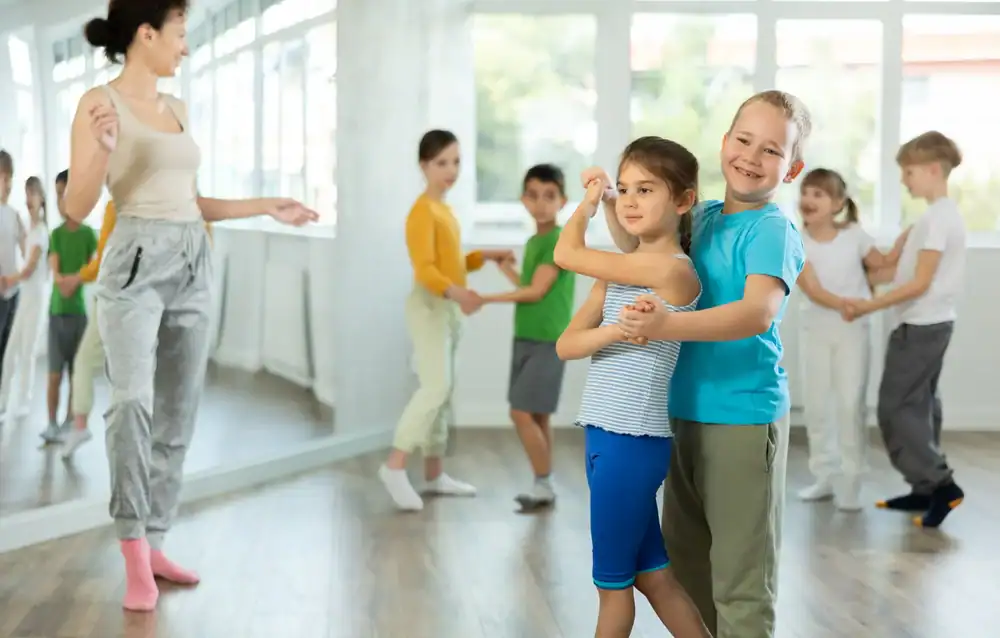
The Foxtrot is often recommended as one of the easiest dances to learn first because it’s forgiving. The tempo is moderate, the steps are straightforward, and the style is smooth. You’re not doing sharp turns or intricate footwork. You’re just gliding across the floor with your partner.
One of the best things about the Foxtrot is how versatile it is. You can dance it to a wide range of music—jazz, swing, pop, even some country songs. That makes it incredibly practical. If you’re at a wedding or a social dance and a mid-tempo song comes on, chances are you can Foxtrot to it.
The Foxtrot also teaches you how to travel. Unlike the Waltz, where you’re mostly staying in one spot, the Foxtrot moves you around the room. That’s an important skill in ballroom dancing. It helps you navigate a crowded dance floor and makes your dancing look more polished.
The basic Foxtrot step is a forward-forward-side-together pattern for the leader, and a back-back-side-together pattern for the follower. It’s repetitive, so once you’ve got it, you can focus on refining your technique—your posture, your frame, your connection with your partner.
One challenge beginners face with the Foxtrot is maintaining momentum. Because you’re traveling, it’s easy to lose steam or get stuck in one corner of the floor. That’s where we come in. We’ll teach you how to use your whole body to generate movement, not just your legs. We’ll also show you how to navigate around other dancers, which is a skill in itself.
Another challenge is the “slow, slow, quick, quick” timing. The slow steps take two beats, and the quick steps take one beat each. If you’re not used to varying your step speed, it can feel choppy at first. But with practice, it becomes second nature. You start to feel the rhythm in your body, and the steps flow naturally.
At Ballroom Factory Dance Studio, we break down the Foxtrot step by step. We’ll work with you on timing, footwork, and frame until you feel comfortable. Then we’ll add turns, variations, and styling to keep things interesting. It’s a progression that builds your skills without overwhelming you.
The Cha-Cha is a Latin dance, which means it has a different flavor than the Waltz or Foxtrot. It’s upbeat, rhythmic, and fun. If you’re someone who likes music with a strong beat and wants to add a little flair to your dancing, the Cha-Cha is a great choice.
The basic Cha-Cha step is simple: rock step, then three steps in place with a shuffle on the last two. That shuffle—cha-cha-cha—is where the dance gets its name. It’s quick, but it’s not complicated. Once you’ve got the rhythm, the rest falls into place.
What makes the Cha-Cha beginner-friendly is its repetition. You’re doing the same basic pattern over and over, just in different directions or with different styling. That repetition gives you a chance to relax and start adding personality to your dancing. You can play with your hips, your arms, your facial expressions. The Cha-Cha invites you to have fun.
One of the challenges with the Cha-Cha is the speed. The music is faster than the Waltz or Foxtrot, so your feet have to move quicker. That can feel overwhelming at first, especially if you’re still thinking about every step. But the beauty of the Cha-Cha is that you don’t have to be perfect. The dance is forgiving. As long as you’re on beat and moving with energy, you’ll look good.
Another challenge is the hip motion. Latin dances emphasize hip movement, which is called Cuban motion. It’s a subtle shift of weight that creates a smooth, fluid look. For beginners, especially those who aren’t used to moving their hips, this can feel awkward. But it’s not about exaggerating the movement. It’s about letting your hips respond naturally to the shift in your weight.
We teach you how to incorporate Cuban motion without overthinking it. We’ll show you how to relax your knees, shift your weight, and let your hips follow. It’s a small adjustment that makes a big difference in how your dancing looks and feels.
The Cha-Cha is also a social dance, which means it’s commonly danced at parties, clubs, and social events. Learning the Cha-Cha doesn’t just prepare you for the dance floor—it prepares you for real-world situations where you’ll actually use it. That makes it a practical choice for beginners who want to feel confident in social settings.
So which dance should you start with? It depends on your goals, your personality, and what kind of music you connect with.
If you want something elegant, slow, and foundational, start with the Waltz. It’s the best dance for building basic skills and confidence. If you’re drawn to classic music and smooth movement, the Foxtrot is a great choice. And if you want something energetic and fun, the Cha-Cha will give you that.
The truth is, you don’t have to pick just one. Most beginners at Ballroom Factory Dance Studio start with one style and then branch out as they get more comfortable. The skills you learn in one dance—timing, posture, connection—transfer to every other dance you learn.
What matters most is getting started. Take a lesson. Try a few different styles. See what feels right. We’ll guide you, answer your questions, and help you find the dance that fits you best. Whether you’re preparing for a wedding, looking for a new hobby, or just want to try something different, ballroom dancing is more accessible than you think—and it starts with that first step.
Summary:
Article details:
Share: