Salsa or bachata — most beginners don't know where to start. Here's an honest look at both so you can make the right call.
Most people who search “beginner salsa lessons” aren’t actually sold on salsa yet. They’re trying to answer a different question: which Latin dance should I start with? It’s a fair question, and almost nobody gives you a straight answer. Studios list their class schedules. YouTube shows you highlight reels. Neither one tells you what it actually feels like to walk in as a complete beginner and try to find the beat for the first time.
We’ll walk you through both dances — honestly — so you can make a decision that actually makes sense for where you’re starting.
Salsa and bachata are both Latin partner dances, both rooted in Caribbean music, and both wildly popular at social events across Suffolk County. But they are not the same dance, and they don’t feel the same to learn.
The biggest practical difference for a beginner comes down to tempo. Bachata runs between 120 and 160 BPM. Salsa typically runs between 160 and 220 BPM. That gap matters more than most people realize when you’re just trying to figure out where your feet go.
Bachata’s slower pace gives you more time to think, more time to listen to the music, and more room to recover when you lose the count — which you will, at first, and that’s completely normal. Salsa moves faster, demands quicker footwork, and requires more rhythmic precision from the jump.
Neither dance is beyond a true beginner. But they ask different things of you in those first few weeks.
Salsa uses an 8-count pattern where you step on beats 1, 2, and 3, pause on 4, then step again on 5, 6, and 7, and pause on 8. Simple enough on paper. But at salsa’s tempo, those counts come at you fast, and the pause — which should feel natural — often trips beginners up because the music doesn’t stop just because your brain did.
On top of the timing, salsa involves hip movement that tends to intimidate people before they even try it. Here’s the thing: the hip motion in salsa isn’t something you force or perform. It’s a byproduct of proper weight transfer. When your technique is right, the hips follow. But getting your technique right takes time, and at salsa’s speed, you don’t have a lot of margin for error while you’re still figuring out the basics.
There’s also the athleticism factor. Salsa at even a social level involves faster footwork, sharper direction changes, and more complex movement patterns than bachata. That doesn’t make it out of reach — plenty of people learn salsa as their first dance and love it. But it does mean the early weeks can feel more frustrating than they would with a slower starting point.
If you’ve never done any partner dancing before, that frustration is worth factoring in. The other thing salsa beginners often don’t anticipate is how much the lead-and-follow connection matters at that speed. In a slower dance, there’s more time for the lead to communicate and the follower to respond. In salsa, the communication has to be cleaner and faster. That’s a skill that develops with practice — but it adds another layer to what you’re juggling as a first-timer.
None of this is meant to scare you off salsa. It’s a beautiful, energetic dance, and once it clicks, it really clicks. Going in with realistic expectations makes the learning process smoother.
Bachata is widely regarded as one of the easiest partner dances for beginners to learn, and the tempo difference is a big reason why. At 120 to 160 BPM, bachata gives you enough space to actually hear the beat, feel it, and move with it — rather than chasing it.
For someone who’s never counted music while moving their body before, that breathing room changes everything. The basic step itself is straightforward: three steps to the side followed by a tap or touch, then three steps back the other way with another tap. That pattern repeats, and once it’s in your body — which usually happens faster than people expect — you start to feel the music rather than think about it.
Most beginners can get to a point where they can dance bachata socially within two to four weeks of consistent practice. That’s not a guarantee, but it’s a realistic benchmark.
Bachata also has a different vibe from salsa. Where salsa tends to be sharp, quick, and energetic, bachata is smoother and more connected. The partner hold is closer, the movement is more flowing, and the overall feel is more conversational. For people who are nervous about looking stiff or robotic on a dance floor — which is almost every beginner — bachata’s style actually works in your favor. The dance is forgiving of small timing imperfections in a way that salsa isn’t.
Don’t mistake “easier to start” for “less impressive.” Bachata at an intermediate or advanced level is as technically demanding and visually striking as any other Latin dance. The learning curve is gentler at the beginning, not the ceiling. Starting with bachata doesn’t mean you’re settling — it means you’re building a real foundation before you add speed and complexity.
One more thing worth knowing: the two dances share enough DNA that learning one genuinely helps with the other. Beginners who start with bachata often find that when they do move into salsa, their sense of rhythm, their partner connection, and their comfort on a dance floor are already developed. The transition is smoother than starting salsa cold.
Want live answers?
Connect with a Ballroom Factory Dance Studio expert for fast, friendly support.
Walking into your first lesson — whether it’s salsa, bachata, or anything else — comes with a certain amount of nerves. That’s true for almost everyone, regardless of age or background. The question most beginners are really asking isn’t “what will I learn?” It’s “will I be the worst one there?” and “will I embarrass myself?”
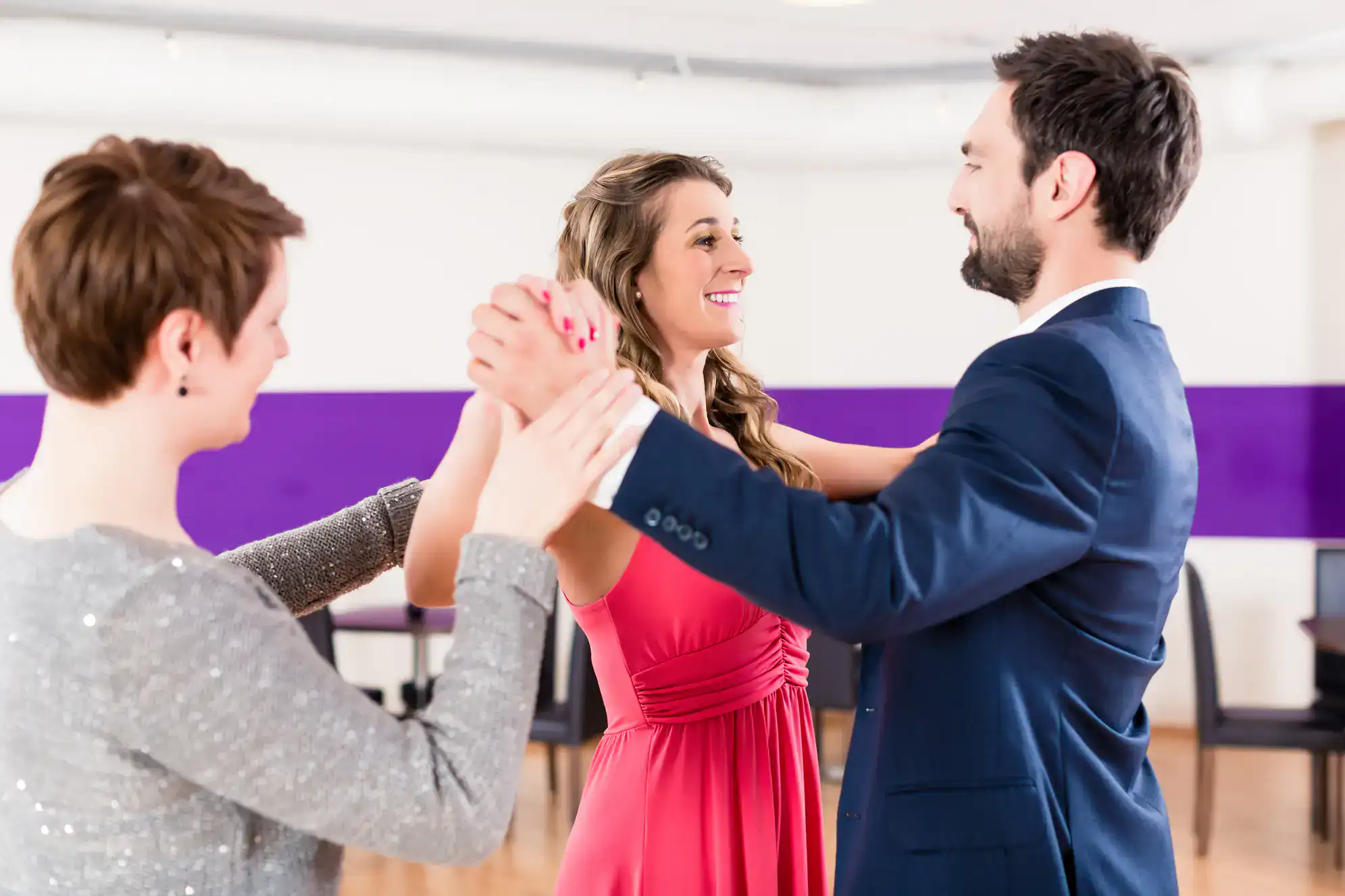
The honest answer is that in a private lesson format, there’s no “worst one in the room” because you’re the only student. You work directly with a professional instructor who adjusts to your pace, your goals, and your starting point — not the other way around. That’s a fundamentally different experience from a group class where the instructor has to move at the average student’s speed.
In your first bachata lesson, you’re not going to be thrown into complicated combinations or partner work right away. A good instructor starts with the foundation: the basic step, the timing, and how to listen to the music. You’ll learn the side-to-side pattern — three steps and a tap — and you’ll repeat it until it starts to feel natural rather than calculated.
That might happen in the first lesson. It might take two or three. Either way is fine. From there, the progression moves into weight transfer, posture, and how to maintain a frame with a partner. These aren’t complicated concepts, but they take repetition to internalize. A skilled instructor won’t rush you through them, because getting these right is what makes everything else easier down the line.
Once the basics are solid, lessons start to introduce simple turns, directional changes, and the beginning of real partner connection. By this point, most students are surprised by how much they’ve absorbed — and how much more natural the music feels than it did at the start. That moment of “oh, I’m actually dancing” tends to happen earlier than people expect.
A good instructor doesn’t just teach you steps — they catch the small technical details that a video tutorial can’t. Things like exactly how much tension to maintain in your frame, how to shift your weight cleanly, or how to listen for the beat when the music is layered. Those are the details that separate someone who learned from YouTube from someone who actually learned to dance. In-person instruction has irreplaceable advantages for exactly this reason.
One thing that makes learning salsa or bachata in Suffolk County particularly worthwhile is that there are real places to use these skills once you have them. Patchogue’s Main Street has become one of the most active social corridors on the South Shore, with restaurants, bars, and live music venues that regularly feature Latin music nights and community events.
Bay Shore, Islip, and the broader Great South Bay area host outdoor festivals in the summer where you’ll hear salsa and bachata played live. These aren’t niche events for dance enthusiasts — they’re mainstream nights out where knowing how to move on a dance floor actually changes the experience.
Having a real destination — a specific event you want to feel confident at — is one of the most powerful motivators for staying consistent with lessons. It’s not abstract anymore. You’re not just “learning to dance.” You’re preparing for something specific and enjoyable.
Suffolk County also has a large and deeply rooted Latin community, particularly along the South Shore in communities like Brentwood, Bay Shore, Central Islip, and Patchogue. Salsa and bachata aren’t novelty dances in this market — they’re part of the cultural fabric. The music plays at quinceañeras, community celebrations, and family gatherings throughout the year. If you live or work in this area and have ever felt like you were on the outside of that world, learning these dances is one of the most direct ways in.
For commuters who ride the LIRR Montauk Line into the city, Patchogue is a natural stop. Our evening hours — Monday through Friday, 2PM to 9:30PM — are designed around people who work during the day and need flexibility in the evening. Private lot parking at our studio means you’re not circling the block after a long commute. It’s a small detail, but it matters when you’re already tired and trying to make a new habit stick.
If you’re a true beginner with no partner dance background, bachata is the more forgiving starting point. The tempo is slower, the basic step is more intuitive, and you’ll feel like you’re actually dancing sooner. That early confidence matters — it’s what keeps people coming back instead of quitting after two lessons.
That said, salsa is absolutely learnable as a first dance, especially with one-on-one instruction that lets you move at your own pace. Here’s the thing most people don’t realize until they’re already taking lessons: you don’t have to choose one forever. Many students start with bachata, build their foundation, and move into salsa within a few months. The skills transfer. The confidence transfers. You’re not locked in.
If you’re in Suffolk County and ready to stop thinking about it and actually try, we’re here to help. Ballroom Factory Dance Studio teaches both styles, works with complete beginners all the time, and we’ll help you figure out where to start based on your actual goals — not just whatever class has an opening.
Summary:
Article details:
Share: