Not sure where to start with Latin dance? This guide breaks down the most popular styles in plain language so you can find the one that clicks for you.
You’ve heard the music. Maybe at a party, a wedding, a restaurant on a Friday night — something about it made you want to move. But then comes the question nobody talks about: which dance is that, exactly? And if you wanted to learn it, where would you even start?
Latin dance isn’t one thing. It’s a whole family of styles, each with its own rhythm, its own feel, and its own learning curve. The good news is that once you understand the differences, choosing where to begin gets a lot easier. Here’s a plain-language breakdown of the most popular Latin dance styles — and what actually sets them apart.
Most people come in knowing they like the music but having no idea what the dance is called. That’s completely normal. Latin dance as a category spans dozens of styles, but a handful dominate social dance floors — and those are the ones worth understanding first.
The big ones you’ll encounter are salsa, bachata, merengue, cha-cha, and rumba. Each has a distinct rhythm, a different energy, and a different physical feel when you’re actually dancing it. They’re not interchangeable, even though they all fall under the Latin umbrella.
What they share is this: they’re all partner dances built on connection, rhythm, and movement that feels good when it clicks. The differences are in how you get there.
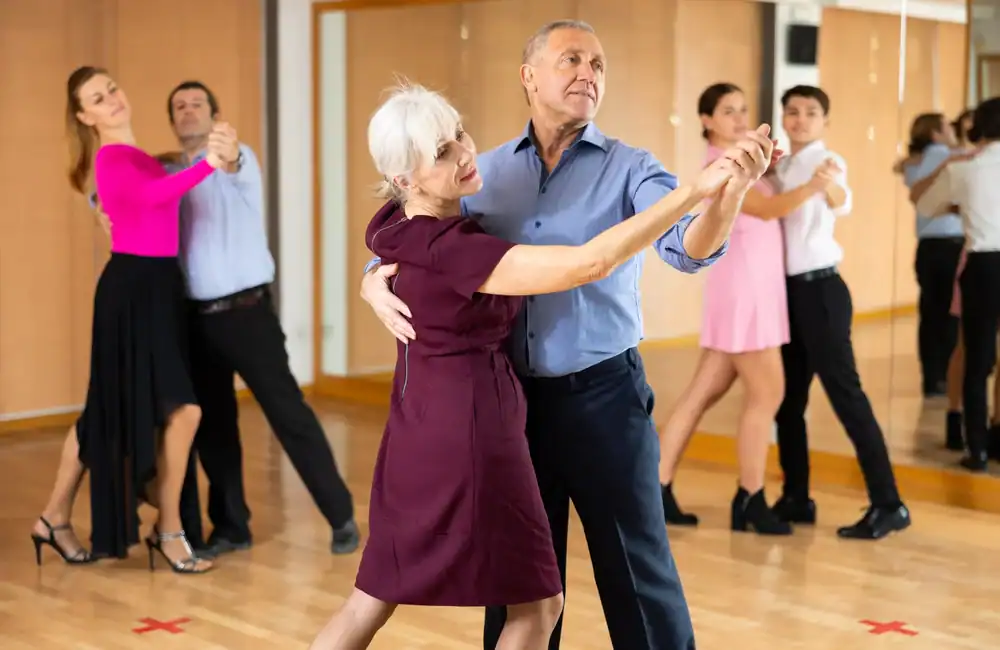
Salsa is probably the style most people picture when they hear “Latin dance.” It’s danced in 4/4 time, built around a syncopated rhythm called the clave — a specific musical pattern that gives salsa its signature push-pull energy. Salsa tends to be faster, more footwork-intensive, and a little more technically demanding than some other styles.
It originated in Cuba and Puerto Rico and has since spread into dozens of regional variations, from New York-style salsa (danced “on 2,” meaning the weight shift happens on the second beat) to Cuban-style salsa, which has a more circular, improvisational character. Once you understand the clave, the music starts to make a lot more sense — and so does the dance.
Bachata is a different animal entirely. It came out of the Dominican Republic and has a slower, more intimate feel. It’s danced in a closed position, and the signature move is a hip accent on the fourth beat of each measure. That subtle hip movement is what gives bachata its distinctive look — and it’s also what makes it so satisfying to dance once you’ve got it.
The slower tempo and close frame make bachata a popular choice for couples, and it’s become one of the fastest-growing social dances in the world over the last decade. If you’ve been to a wedding recently and heard something that sounded romantic and slightly hypnotic, there’s a good chance it was bachata.
Merengue is where most beginners breathe a sigh of relief. It’s danced in 2/4 time — essentially a march beat — which makes it the most rhythmically straightforward of the major Latin styles. The footwork is simple: step, step, step, step, with a characteristic hip sway that comes naturally once you relax into the music.
Merengue is the style instructors often use to help new students find their footing before moving into more complex rhythms. It’s not “easy” in a dismissive sense — it has its own nuances — but the entry point is genuinely accessible, even if you’ve never danced a day in your life.
Once you’ve got your bearings with salsa, bachata, or merengue, you’ll likely start noticing other styles on the floor. Cha-cha is one of the most recognizable — it’s named for the sound its footwork makes, a quick “cha-cha-cha” on beats four and the “and” of four. It’s playful, flirtatious, and a little cheeky in character.
Cha-cha is danced in 4/4 time and shares some DNA with mambo, though it’s generally considered more accessible for beginners. The rhythm is distinct enough that most people can identify it quickly once they know what to listen for.
Rumba is slower and more sensual than cha-cha. It’s often described as the dance of love — the movements are deliberate, the connection between partners is central, and there’s an emphasis on expressing emotion through controlled, flowing motion. Rumba is one of the five International Latin dances recognized in competitive ballroom dance, which tells you something about its staying power and technical depth.
That said, it’s also a genuinely beautiful social dance, and many students are drawn to it precisely because of how expressive it feels.
Samba is the outlier in the group — it’s Brazilian in origin, tied to the energy of Carnival, and has a distinctly different bounce to it. Samba is danced in 2/4 time with a characteristic “samba bounce” that comes from a specific knee action. It’s energetic, rhythmically complex, and a lot of fun once you’ve got the bounce under control.
It takes a bit more time to feel natural than some other styles, but the payoff is a dance that’s genuinely unlike anything else on the floor. The reason it’s worth knowing all of these — even if you’re only planning to learn one — is that Latin music doesn’t always stay in one lane. A night of social dancing in Suffolk County might move from salsa to bachata to merengue in the span of an hour.
Want live answers?
Connect with a Ballroom Factory Dance Studio expert for fast, friendly support.
Suffolk County has a real and growing community of people who love to dance, and we’re here to serve them well. If you’re thinking about taking your first Latin dance class with us, the format matters as much as the style. Private lessons and group classes serve different purposes, and understanding the difference helps you set realistic expectations from the start.
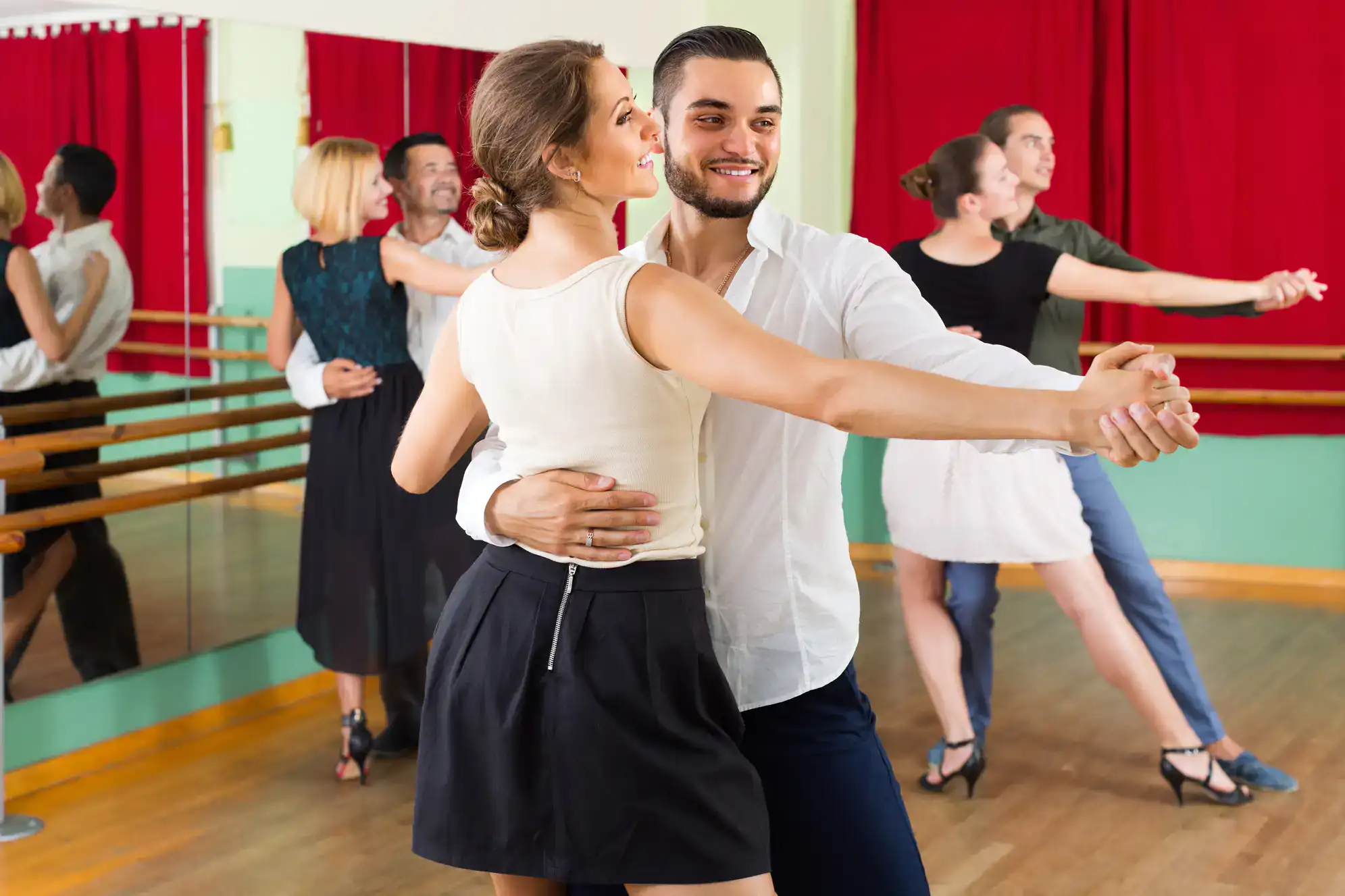
Private lessons are where most serious progress happens. You’re working one-on-one with an instructor who can watch exactly what you’re doing, correct it in real time, and adjust the pace based on how you’re responding. There’s no keeping up with a class, no trying to absorb something while simultaneously watching someone else demonstrate it. It’s just you, the music, and someone who’s focused entirely on helping you improve.
For beginners especially, private lessons remove a lot of the social pressure that keeps people from trying in the first place. You’re not performing for anyone. You’re not the slowest person in the room. You’re just learning — and that’s a very different experience than what most people imagine when they picture a dance class.
Group classes serve a different function. They’re where you practice what you’ve learned in private lessons with multiple partners, which is essential for social dancing. Partner dancing is a conversation — and like any conversation, you get better at it by having it with different people. Group classes also build community. You start recognizing faces, you start feeling comfortable on the floor, and the studio becomes a place you actually want to be rather than just a place you go for lessons.
At Ballroom Factory Dance Studio in Patchogue, we offer both formats, and many students use them together. Private lessons build the foundation; group classes and our Friday evening social events give you somewhere to use it. That combination — structured learning plus real-world practice — is what actually turns a curious beginner into someone who can hold their own on a dance floor.
One thing worth addressing directly: you don’t need a partner to start. We rotate partners in group classes, and private lessons obviously don’t require one. A lot of people in Suffolk County come in solo — single adults, people whose partners aren’t interested, couples where one person is more motivated than the other. All of it works.
The most common thing people say before their first lesson is some version of “I’m not a dancer.” It comes out as “I have two left feet,” or “I have no rhythm,” or “I’ve never danced in my life.” What it really means is: I’m afraid I’ll look foolish, and I’m not sure this is something I can actually do.
Here’s what’s true: rhythm is a learned skill. It’s not something you either have or don’t. The clave in salsa, the hip accent in bachata, the bounce in samba — none of these come naturally to most people at first. They come from repetition, from a good instructor who knows how to break things down, and from giving yourself permission to be a beginner for a while.
We hear this from students regularly. People walk into Ballroom Factory Dance Studio nervous and uncertain, and something shifts once the lesson actually starts. The environment matters — a lot. A studio where you feel welcome and unjudged is a completely different experience from one where you feel like you’re already behind. Our instructors, including Pavel and Mitch, are known for exactly this: they watch, they coach, they adjust, and they make the process feel manageable rather than overwhelming.
Age is another thing people worry about unnecessarily. Suffolk County has a large population of working adults, many of them well into their 40s, 50s, and beyond, who come to us with zero prior dance experience and leave with a skill they genuinely love. Latin dance is not a young person’s sport. The connection, the musicality, the social dimension — these things actually get richer with time and life experience.
If you’re on the fence because you’re not sure you’re “the type,” consider that the people who say that most often are exactly the ones who end up loving it most. The hesitation is normal. It doesn’t mean you’re not ready.
Salsa, bachata, merengue, cha-cha, rumba, samba — they’re all worth knowing, and they all start the same way: with one lesson and a willingness to try something new. You don’t need to pick the “right” style before you walk in. That’s what the first lesson is for.
We’re located in Patchogue and open Monday through Friday, 2:00 PM to 9:30 PM. Reach us at (631) 868-3500 or office@ballroomfactory.com. Let’s find your dance.
Summary:
Article details:
Share: