Thinking about salsa classes but not sure where to begin? Here's everything you need to know before your first lesson.
Most people who sign up for their first salsa class will tell you the same thing: they almost didn’t come. They figured they were too old, too stiff, too uncoordinated, or just not “the dancing type.” Then they showed up anyway — and everything shifted. If you’re somewhere in that in-between place right now, curious but not quite convinced, this page is for you. We’ll walk you through what salsa dancing actually involves, what the first few lessons look like, how it connects to styles like bachata and rumba, and what makes learning it at Ballroom Factory in Suffolk County feel like more than just a hobby.
Salsa is a partner dance with roots in New York City and the Caribbean — which means if you’re learning it here in Suffolk County, you’re learning it in its backyard. At its core, salsa is built on a simple eight-count rhythm, a basic forward-and-back step, and the connection between two people moving together. That’s it. Everything else — the turns, the styling, the footwork — gets layered in over time.
What surprises most beginners is how quickly the basics start to feel natural. You don’t need prior dance experience. You don’t need a partner. And you definitely don’t need to look good doing it on day one. The goal in those first few lessons is just to find the beat and get comfortable moving — and that’s something any adult can do with the right instruction.
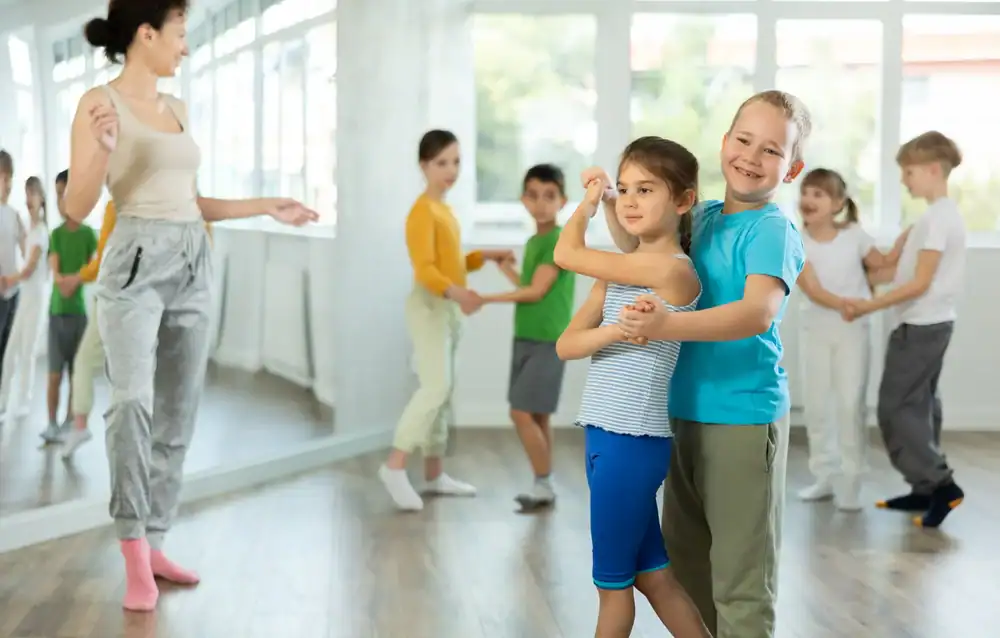
A beginner salsa dance class typically starts with the foundation: the basic step. Our instructors break down the timing, show you where your weight goes, and walk you through it slowly before you ever think about a partner. In a well-structured class, nothing gets rushed. You move at the pace that makes sense for you, not the pace of whoever happens to be the fastest learner in the room.
From there, beginner salsa dance lessons build progressively. You’ll learn how to connect with a partner — how to lead or follow without forcing it — and how to navigate simple turns and combinations. Good instruction makes this feel less like memorizing a routine and more like having a conversation with your feet. The mechanics become second nature faster than most people expect.
One thing worth knowing going in: group classes rotate partners. That might sound intimidating, but it’s actually one of the best things about the format. Dancing with different people teaches you to adapt, builds your confidence faster, and takes the pressure off any one connection. If you’d rather start one-on-one, private dance lessons for adults are available and give you the same progressive curriculum at a pace that’s entirely your own.
A lot of adults in Suffolk County come to their first class carrying years of “I can’t dance” as a fixed belief. What they find instead is that they were never given the right environment to try. Beginner dance classes for adults are designed around exactly that reality — the assumption is that you’re starting from zero, and that’s completely fine.
This is the question almost every new student asks, and the honest answer is: it depends on what “learning salsa” means to you. If your goal is to feel comfortable at a wedding or a social event — to get on the floor, stay on beat, and not panic — most adults reach that point within a handful of lessons. That’s a realistic, achievable outcome, and it’s one of the most common reasons people across Suffolk County sign up in the first place.
If you want to go further — to dance with real fluency, to handle turns and combinations smoothly, to feel at home on any dance floor — that takes more time. But it doesn’t take as long as people assume. Dance builds on itself. Each lesson reinforces what came before, and muscle memory starts doing a lot of the work after the first few weeks. Most students are genuinely surprised by how quickly they progress when the instruction is individualized and the environment is supportive.
What slows people down isn’t a lack of talent. It’s inconsistency and anxiety. Students who come in regularly, stay relaxed, and trust the process tend to outpace their own expectations. The adults who come to us convinced they have “two left feet” are often the same ones who become the most enthusiastic students after a few months — because they stopped expecting to be bad at it and started enjoying the process instead.
The timeline also depends on whether you’re taking private dance lessons for adults, group dance classes, or a combination of both. Private instruction accelerates progress because every minute of the lesson is focused on your specific gaps and goals. Group classes add a social dimension that private lessons can’t fully replicate. Many students do both.
Want live answers?
Connect with a Ballroom Factory Dance Studio expert for fast, friendly support.
Most people come in asking about salsa and leave curious about bachata. That’s not an accident — the two styles are closely related, they’re often taught and practiced together, and bachata has exploded in popularity over the past decade for good reason. But the Latin dance world goes further than that. Rumba, merengue, cha-cha, samba — each one has its own character, its own rhythm, and its own appeal.
Starting with salsa gives you a foundation that transfers directly to other Latin styles. The partner connection, the weight shifts, the sense of timing — these carry over. Students who start with beginner salsa dance classes often find that picking up bachata or cha-cha afterward feels surprisingly natural. You’re not starting over; you’re building on what you already know.
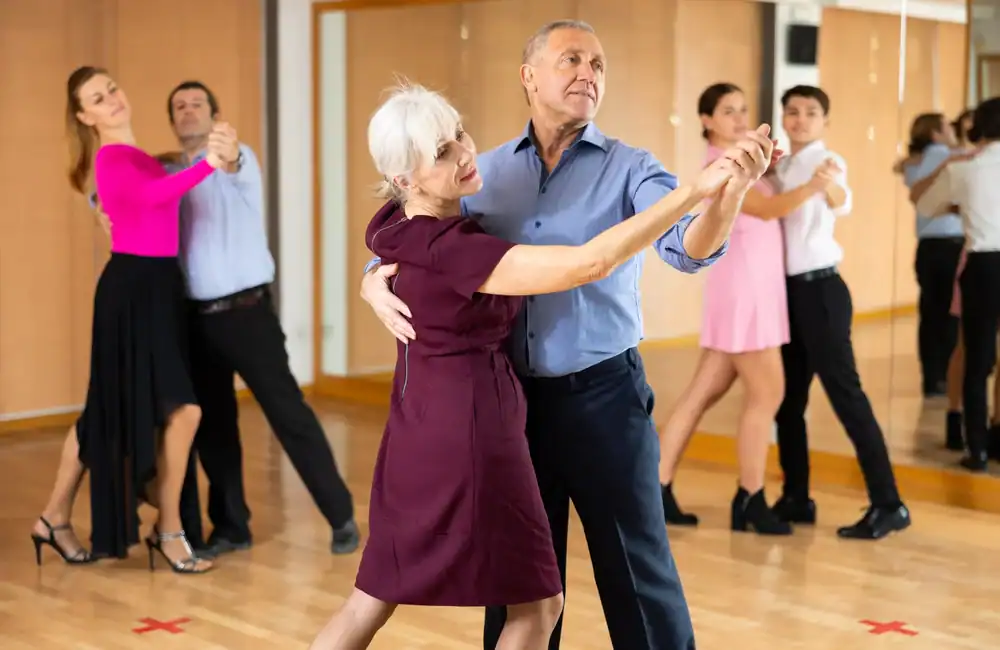
Bachata originated in the Dominican Republic and has a reputation for being more approachable than salsa for absolute beginners. The rhythm is simpler, the footwork is more grounded, and the close-hold connection between partners gives the dance a warmth that a lot of people respond to immediately. If salsa feels like a conversation, bachata feels like one where neither person is in a hurry.
Bachata basic steps for beginners follow a side-to-side pattern in counts of four, with a small hip accent on the fourth beat. It sounds technical written out, but in practice it clicks quickly. Most students who try bachata for the first time find themselves smiling within the first ten minutes — which is not always how their first salsa lesson goes.
For couples especially, bachata tends to be the style that sticks first. The close hold, the shared rhythm, the unhurried pace — it creates a kind of connection that’s hard to replicate in other activities. That’s part of why couples salsa classes often end up doubling as bachata lessons once students realize what’s available. Learning to dance bachata together is genuinely one of the better date-night activities in Suffolk County, and it tends to become a regular one.
Bachata lessons for beginners at our studio follow the same progressive approach as salsa — foundation first, combinations later, confidence throughout. You don’t need to choose between the two styles. Many students learn both simultaneously, and the overlap between them makes each one easier.
The rumba is the slowest of the Latin dances and often described as the most romantic. The rumba basic step — a box pattern danced in slow-quick-quick timing — teaches body movement and weight transfer in a way that benefits every other Latin style you’ll learn. It’s a foundational dance, and many instructors use it to help students develop the hip motion and floor connection that salsa and bachata both rely on.
For adult beginners, the rumba is also one of the least intimidating entry points into Latin dance. The slower tempo gives you more time to process what your body is doing, which makes it easier to absorb the technique. Students who struggle with salsa’s quicker pace often find that a few rumba lessons unlock something — they come back to salsa with better body awareness and more control.
Rumba also has a strong presence in the ballroom world, which means students who eventually want to explore competitive dancing or simply want a broader dance vocabulary will encounter it regardless of where they start. At Ballroom Factory, we teach 14 dance styles in total — salsa, bachata, rumba, cha-cha, merengue, tango, waltz, foxtrot, samba, jive, hustle, swing, Viennese waltz, and more. Students who start with one style rarely stop there. The variety is part of what keeps people coming back, and it means you’ll never have to switch studios as your interests grow.
For adults in Suffolk County who want to feel genuinely comfortable at any social event — a wedding in Sayville, a quinceañera in Bay Shore, a holiday party in Patchogue — having a working knowledge of two or three Latin styles makes a real difference. You’re not just learning steps. You’re building a skill set that travels with you.
You don’t need to be in shape, in a relationship, or in any way “ready” to start taking salsa classes. The only thing that matters is showing up. Everything else — the footwork, the timing, the confidence — gets built from there. One of our students, a single man in his fifties who had never danced before, described finding Ballroom Factory after two years at another studio as “the best decision I’ve ever made.” That’s what happens when the instruction is personalized and the environment actually makes you feel welcome.
Our studio is open Monday through Friday, 2:00 PM to 9:30 PM, at 620 Waverly Ave, Suite H, in Patchogue — right in the heart of one of Suffolk County’s most vibrant communities. Whether you’re a complete beginner, preparing for a wedding first dance, or just looking for something genuinely worth doing after work, we’d love to hear from you. Call us at (631) 868-3500 or email office@ballroomfactory.com to ask about class schedules and how to get started. Ballroom Factory Dance Studio is here when you’re ready.
Summary:
Article details:
Share: